Saturday, March 26, 2016

Another year, another anniversary

As events marking the 5th anniversary of the March 11, 2011, disaster continued, last Sunday I was honoured to be invited to participate in a symposium organized by NPO Chikurin-sha (INFO).  Other panelists included two people who had evacuated from Fukushima to the Tokyo area and two whom have not been able to evacuate.  
To represent those who had not been able to evacuate was Mrs. Sugano, who attended the conference with her husband and children.  The Sugano's are one of the main families documented in my film 'A2-B-C' (website), and it is always wonderful to see them.

With the recent stepping down (firings?!) of some major broadcast journalists (news story HERE) and the outrageous statement of Sanae Takaichi, Japan's communications minister, about the "possibility of shutting down television companies that flout rules on political impartiality" (news story HERE), on Thursday I attended the press conference "Japan's Journalists Speak Out" at the Foreign Correspondents' Club of Japan (INFO).
The journalists were resolute in sharing their thoughts and even felt comfortable enough to debate with each other about what they see as the root of the problems, including if the pressure was external (by the government) or self-inflicting (self-censorship).  Some quotes I found particularly interesting:
Shigetada Kishii: "Journalism is here to check and criticize the government.  If we can not do that, then the media is dead."

Soichiro Tahara: "The Constitution guarantees freedom of speech and expression, and the Constitution is more important than the Broadcast Law."

Akihiro Otani: "NHK is  not present today.  The foreign media is here, but not the national broadcaster.  This demonstrates the problem here today.  This (control of the media) is something that is unthinkable in (other democracies).  This is something that should only happen in an extreme dictatorial state."
The entire press conference can be seen on the FCCJ channel, HERE in English, 日本語ここ.


Today, I spent the day in Gifu at the beautiful Entokuji Temple  where a conference was held by the Preserving Deciduous Teeth Network (PDTN). Following the Fukushima nuclear disaster, this group is working to create "a nationwide network of people contributing their children's shed deciduous teeth. The collected teeth will be examined to determine the concentration of Strontium-90 deposited within them" (INFO).  I was invited to attend the conference by Dr. Ichihara, whom I had met in Berlin last month when screening the rough cut of my latest documentary about Fukushima (STORY). 
When I arrived, I was happy to also see Dr. Matsui and his wife, whom I had last met nearly two years ago when Dr. Matsui led the post-screening discussion of the final cinema showing in Tokyo of my film 'A2-B-C' after the theatrical run in the capital (STORY).  I had first met Dr. Matsui several months earlier in Germany while attending THIS IPPNW conference about Chernobyl and Fukushima.

At the conference in Gifu, two amazing films by Wladimir Tchertkoff about the disaster at Chernobyl, 'Le Sacrifice' (2003) and 'Controverses Nucléaires' (2003), were screened accompanied by a talk given by the director himself.  For anyone interested in nuclear issues, these two films are essential viewing.

Now, as April approaches, I wonder how many people are still thinking about Fukushima.  "Will it take another year, another anniversary for people to remember?" I wonder, as I head back into the edit suite to finish my new documentary about children living amid contamination...

Tuesday, March 15, 2016

Screenings, Effect

During the marking of the 5th anniversary of the March 11, 2011, disasters, screenings of my documentaries about the effect on children of the nuclear disaster in Fukushima were held in several cities around the world and in Japan (screenings in Canada, Germany HERE, Japan domestic screenings HERE).  Just back from screenings in Germany and Ireland (STORY), my assistant, Rei, and I traveled to Nagano Prefecture on Friday, March 11, to attend screenings of my film "In the Grey Zone" (WEBSITE) on Saturday (screening INFO).

On the way to Nagano, I received a notice about an extremely important press conference that had been suddenly scheduled about a group that had formed for families with children who have been diagnosed with thyroid cancer after the nuclear disaster; it was scheduled for the following day when we were supposed to be in Nagano for the screenings.

This issue of post-Fukushima pediatric thyroid cancer is the main theme of my new documentary, and I felt I needed to be at the press conference in Tokyo.  Arriving in Nagano on Friday evening, I held my breath as I told the screening organizers about the press conference and asked for their understanding in my desire to return to Tokyo first thing in the morning, thus missing the Saturday screenings which I had come all the way to Nagano to attend.  I explained that their desire to show my film and create a dialogue in their community about what has happened in Fukushima was directly tied to my desire to return to Tokyo and continue to document the current situation.  After a long discussion at dinner, during which the board members debated the pros and cons of suddenly cancelling my advertised appearance at the screenings (and during which my nerves did not allow me to eat), the board members decided to give me their blessing to return to Tokyo to attend the press conference and we agreed that I would take part in the post-screening discussion via video phone from outside the press conference directly after it was finished (explanation from the Nagano screening group HERE).

from the FB page of screening organizer Mr. Obata.
Back in Tokyo after leaving Nagano first thing Saturday the morning, we attended the press conference given by three organizing members of the 311 Thyroid Cancer Family Group, along with two fathers of Fukushima children who have developed thyroid cancer.  The fathers took part in the press conference in Tokyo via Skype from Fukushima, but they did not show their faces and their voices were electronically altered.  During the question period, Rei asked the fathers to talk about their need to hide their identities.  In response, one father expressed concern about discussing his child's thyroid cancer when there was not direct proof it was caused by exposure to radiation.  The other father spoke of his desire to protect his children's future and his fear of the possibility of some kind of repercussion or negative effect from speaking out.

Group founding member Dr. Ushiyama speaks
one of the fathers speaks at the press conference via Skype
My assistant, Rei, asks his question to the fathers
Journalists covering the press conference
Immediately after the press conference ended, we hurried to a Karaoke Bar near the venue, where we had rented a sound-proof Karaoke box from which I took part in the post-screening discussion of "In the Grey Zone" in Nagano via video phone.

The next day, we traveled to Fukushima, where a screening of my film 'A2-B-C' (WEBSITE) was being held in Sukagawa City in the beautiful (and delicious!) veggie restaurant Ginga No Hotori (screening INFO).


During the Q&A, I was delighted to be able to present a scene from my new film (the work-in-progress I screened in Germany in Ireland) featuring the decontamination activities of Fukushima fathers Mr. Suzuki and Mr. Murakami.  It was an honour to have them both in attendance at the screening and to hear from them directly about their activities.


The screening was a wonderful opportunity to see some familiar faces (including one who appeared in 'A2-B-C'!) as well as to meet some new supporters.

Photo from Suzuki Yohei


Friday, March 11, 2016

Five years.

Today marks five years since the March 11, 2011, triple disasters of earthquake, tsunami and nuclear meltdown.  As I travel this weekend to events and screenings marking this solemn anniversary, I reflect on the events of the past five years and on the sacred stories that have been shared with me by those who were most affected.

===============================================

Originally posted last year on the 4th anniversary, I am re-posting below some of my early short documentaries and trailers about the 3.11 disasters.

Documenting 3.11: the first ten days

My journey documenting 3.11 started with the first entry I wrote (HERE) and a short documentary I filmed about panic buying in Tokyo a couple of days after the disaster (story HERE).  This was followed by several short documentaries posted in quick succession.  A compilation VIDEO of all of these early short documentaries that I edited together and posted for the 2nd anniversary is below, and the accompanying guest blog published by Discovery News is HERE with a list of other blogs I wrote for Discovery News listed at the bottom of THIS entry).  The full collection of my early short documentaries about the disaster is HERE.

Documenting 3.11: One month later
After reading a newspaper article describing the government's plan to re-open schools near the zone 20-30km from the nuclear power plant just one month after the nuclear disaster, I traveled to Fukushima with friend and cameraman Colin O'Neill.  We documented the children living there, and soon after we returned to Tokyo we posted a four part "making of" documentary, beginning with this Video (part 1 below, all 4 parts HERE)


This would become my first feature documentary about the disaster, 'In the Grey Zone' (TRAILER below and website HERE):


Documenting 3.11: Six months later
Six months later while editing 'In the Grey Zone' in Japan with friend and colleague Ed Ison, Colin and I traveled back to Minamisoma City in Fukushima where we filmed an update that we posted in three parts (Part 1 story HERE and VIDEO below, stories about Part 2 HERE and Part 3 HERE, with all three VIDEOS HERE).


Documenting 3.11: One year later

For the 1st Anniversary of the disaster in March 2012, I filmed a three-part update about the children living in the 20-30km zone which I posted to my channel (Story Part 1 HERE, Part 2 HERE and Part 3 HERE, VIDEO part one below, all three videos HERE):


Documenting 3.11: Fifteen months later

A couple of months later, I returned to Fukushima, this time with friend and cameraman Koji Fujita, and in the summer of 2012, I posted two short films about the continuing nuclear disaster.  The first of these was 'Nuclear Refugees: the people of Iitate Village, one year later' (story HERE and VIDEO below):

The second short documentary I posted that summer was 'In Containment', a five-part series that documented some shocking revelations about life in Fukushima after the disaster and found me entering the no-go zone for the first time (VIDEO for Part 3 below and those for Parts 2, 3 and 4 HERE).  During the filming and editing of 'In Containment', I realized I was uncovering a story much larger story than just an "update", and that I had in fact started making a new film.  Parts 1 and 5 would eventually form the beginning of my second feature documentary about the Fukushima disaster, 'A2-B-C' (website ENGLISH/ 日本語).

Documenting 3.11: The children in Fukushima

I continued filming throughout the autumn of 2012 and early winter of 2013, focusing on the children and families living in Fukushima.  Posting the trailer in February of 2013 (TRAILER below), it was serendipitous that the last day of editing I did on the film before handing it off to Ed and Colin back in the UK to finish the post-production was on March 11, 2013, the second anniversary of the disaster (STORY).

Documenting 3.11: The story continues

I am currently finishing the follow-up to 'A2-B-C', in what will be the third film in my series about Fukushima, the work-in-progress of which I recently screened in Europe (STORY).  Thank you all so very much for your continued support and encouragement.

Thursday, March 10, 2016

Progress in working

It was an honour to travel to Germany and Berlin over the past ten days to present two of my documentary films during events marking the 5th anniversary of the March 11, 2011, disaster in Japan.  The first of these was on February 27 in Berlin with a work-in-progress screening of my newest documentary at the international congress “5 years living with Fukushima - 30 years living with Chernobyl” sponsored by the International Physicians for the Prevention of Nuclear War (INFO).  This film is my third in my series about families with children living in Fukushima after "In the Grey Zone" (2012 WEBSITE) and "A2-B-C" (2013 WEBSITE).  IPPNW has screened my films before (HERE, for example) and also used my photographs in their publications (HERE, for example).

The congress in Berlin was an amazing opportunity to receive feedback about the film from medical professionals and specifically doctors who have extensive experience both working in and researching  heath effects after the nuclear disasters in Chernobyl and Fukushima.  I will carry their feedback, questions, and comments from the post-screening Q&A led by Dr. Alex Rosen (photo below) with me as I prepare to lock picture, finish the film, and begin submissions.


After attending the congress in Berlin, I flew to Cork, Ireland, where I presented my films 'A2-B-C' and the work-in-progress of the newest film in the series, and gave a lecture (March 1 and 2 INFO).  This was at the generous invitation of professor Dr. Till Weingartner, whom I had first met three years ago when he was my "translator" at the world premier of 'A2-B-C' (photo and story HERE).  Dr. Weingartner is now a lecturer in Contemporary East Asian Studies at the University College Cork.


On March 3, we moved on to Dublin, where 'A2-B-C' was screened at the University of College Dublin with the support of the UCD Japanese Society and Experience Japan (INFO).  The pre-screening talk and post-screening Q&A were led by the UCD School of Social Policy, Social Work and Social Justice's Dr. Naonori Kodate (photo below).  It was an honour to screen before an audience of mostly young people and to hear their questions/ comments nearly five years after the disaster.


Taking a few days off from work at the end of the trip, I had an opportunity to explore a bit of Dublin and then to take the ferry over to North Wales, where I visited friends and the family grave.  


Freshly back from the trip, there is much to think about and reflect upon.  However, there is not much time to settle back in as these screenings were just the first in a series of events I will attend that are marking the 5th anniversary of the March 11, 2011, triple disasters of earthquake, tsunami and nuclear meltdown; I leave tomorrow for domestic screening in Nagano and Fukushima.  Thank you all so very much for your support and encouragement over these five years.
Peace,
Ian 
Tokyo, Japan

Tuesday, February 23, 2016

Here we go again...

I can hardly believe it myself, but since entering the edit suite 30 days ago after finishing my NHK television documentary "Dying at Home" (INFO), I am already getting ready to complete my next feature documentary (!).  With the amazing help of my assistant, Rei (along with plenty of coffee, chocolate and little sleep), we have met a deadline that at one point, as recently as the New Year, did not seem achievable.  We have just now finished the subtitles and the file for screening is currently compressing.  And just in time- we fly to Europe the day after tomorrow where we are screening it on Saturday.


With the working title of 「せざるを得ない」 ("Seizaruwoenai" or "Unavoidable" in English), the film is my third in my series about families with children living in Fukushima after "In the Grey Zone" (2012 WEBSITE) and "A2-B-C" (2013 WEBSITE).  I am still working on the trailer, final title, website, synopsis information and the plan for releasing the film, but I look forward to sharing more news about the film in the coming months.

While it is still not completely finished, a work-in-progress screening will be held on Saturday (Feb 27) in Berlin at the international congress “5 years living with Fukushima - 30 years living with Chernobyl” sponsored by the International Physicians for the Prevention of Nuclear War (INFO).

Not wanting for the first time for me to see it to be in a room full of delegates at the congress, I have also arranged a small preview screening in Tokyo tomorrow evening (Feb 24 DETAILS).

After attending the congress in Berlin, we will fly to Ireland, where I will be presenting some of my work and giving lectures in Cork on March 1 and 2 (INFO) and then in Dublin on March 3 (INFO).

These screenings will the first in a series of events I will attend that are marking the 5th anniversary of the March 11, 2011, triple disasters of earthquake, tsunami and nuclear meltdown.  Thank you all so very much for your support and encouragement over these five years.

Saturday, February 20, 2016

'-1287' awarded Best Doc at 2016 SoCal FF

The past month has seen me editing faster, longer and for more consecutive days than I have for a while.  Editing is different from directing, and this time in the edit suite has reminded me how much I love editing.  While there have been some sacrifices, like having the time to correspond in a timely manner--- my apologies, I will reply to you all soon!  ;) --- I am looking forward to sharing more about what I am working on in the coming days.

In the meantime, I woke up this morning to the humbling news that my feature documentary '-1287' (WEBSITE) was awarded Best Documentary in the 2016 SoCal Film Festival (festival notice here).


Friday, February 05, 2016

MC FCCJ IPPNW FK5/ CH30

It was my honor to serve as the MC for yesterday's  press conference "The Risk of Low Dose Radiation" given by Angelika Claussen, Medical Doctor & European vice-president of International Physicians for the Prevention of Nuclear War (IPPNW).  Held at the Foreign Correspondents' Club of Japan (FCCJ press release HERE), Dr. Claussen presented her research about the Ukraine, Belarus and Eastern Europe following the Chernobyl nuclear disaster, as well as her work pertaining to the Fukushima nuclear disaster.  Dr. Claussen's trip to Japan was arranged ahead of the IPPNW's upcoming publication "5 years living with Fukushima - 30 years living with Chernobyl".  

The full video of the press conference can be found HERE and below.


Monday, January 18, 2016

Juggling film

Working on several films simultaneously is like a juggling act, and trying to switch the gears in my head quickly between projects can be quite challenging.  While my aim is to never drop one of the balls, I am also not always able to follow them as they orbit through the air.

An example of this is when I am not able to accompany one of my films to screenings abroad.  While the past three years have seen me traveling abroad nearly every month for screenings in international festivals and conferences, 2016 will see me locked down in the edit suite for the most part as I am currently in post-production for three different feature documentaries that I have been working on for the past several years in the background between trips abroad.

Although I will not be there in person, I will be there in spirit for these upcoming screenings of my film '-1287' (2014).  It is such an honour that this film continues to be programmed and resonate with audiences around the world.  Thank you all so very much for your support!

Detailed information about '-1287' and these upcoming screenings can be found on the film's website (HERE).


NEW YORK
Snowtown Film Festival
Watertown, NY, January 29-30, 2016
January 30 at 11:00AM

OREGON
Lane Honors Program, Lane Community College
Eugene, Oregon,
February 3 at 4:30PM

CALIFORNIA
SoCal Film Fest
Huntington Beach, California, February 10-13, 2016
February 11 at 4PM

TAIWAN
Taiwan International Ethnographic Film Festival Tour
Various cities, Taiwan, March-June 2016
Screening cities, dates and times TBA

========================== January 24, 2016 UPDATE =====================

Ahead of the screening in Snowtown Film Festival, THIS article was published in my hometown newspaper, the Watertown Daily Times.


Thursday, January 14, 2016

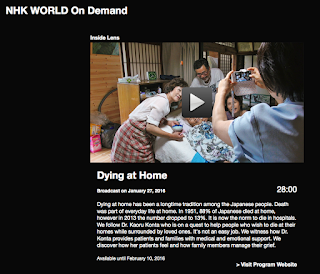
Dying at Home

 ***** UPDATE January 28, 2016 at 22:00 START *****

"Dying at Home" is now available to watch FREE online worldwide until February 10, 2016 on the NHK World website (HERE).   Thank you all so much for watching and for your support!


http://www3.nhk.or.jp/nhkworld/en/vod/insidelens/20160127.html

 ***** UPDATE January 28, 2016 at 22:00 END *****

It has already been a wonderful but busy start to the new year.  After the winter break split between visits with family in the US and Japan, I was back to work on the documentary program commissioned by NHK World.  I have been working on the film, called "Dying at Home", since last summer, and we locked picture on it last month (STORY).  Last week, we completed the English subtitles for the film, and the materials for the PR of the film were prepared.  The 28-minute program, about Dr. Konta, a home physician in Fukushima, will be premiering across the globe on NHK World on January 27 (more info on that below).

Not wanting to lose momentum, I traveled back to Fukushima last weekend to continue filming for the feature version of the film.  While the 28-minute version documents the time I spent with Dr. Konta over five months last year, the feature version will document an entire year of home visits with her patients over the backdrop of Mount Bandai and Lake Inawashiro changing colours across four gorgeous seasons.

Photo from this week's shoot in Fukushima, courtesy Dr. Konta's Facebook page
Although the 28-minute version will only be screening on NHK World, "Dying at Home" will be featured on NHK 1, the main channel in Japan, on a show called "Doki Doki World TV".  Filmed in November (PHOTOS), that program will be airing this coming Sunday (Jan 17) at 10:40pm on NHK1 (INFO).


"Dying at Home" be screening four times on January 26/ 27/ 28 (depending on your time zone), and can be viewed across the globe via LIVE streaming on the NHK World website (info and schedule HERE).   Thank you all so very much for your support!

Broadcast Schedule JST (Japan) 
  • Wed, Jan 27 at 8:30
  • Wed, Jan 27 at 14:30
  • Wed, Jan 27 at 21:30
  • Thurs, Jan 28 at 2:30
***** The above website should list the schedule for the timezone in which it is accessed.  For times on the NHK World channel, please check the local listings. *****


 ***** UPDATE January 17, 2016 at 23:00 *****

Here are some stills from tonight's broadcast of Doki Doki World TV on which I appeared to promote the upcoming broadcast of "Dying at Home":


Thursday, December 31, 2015

2015 Year in Review

Thanks to so many family and friends, 2015 has been another year full of humbling experiences.  In 2013, I began posting the year's highlights (HERE), a tradition I continued in 2014 (HERE).  The highlights for 2015 are below.  Thank you all so very much for your continued support and encouragement.

Peace,
Ian

====================================================================

JANUARY
The year began with continued Japan domestic screenings of my documentary 'A2-B-C' (WEBSITE) in Tokyo (HERE) and Beppu (HERE).  Later in the month, I was invited to speak at Sophia University in Tokyo (HERE).

FEBRUARY
My short documentary "Even the Birds Need to Be Loved" was awarded at the Snowtown USA Film Festival (INFO).  The first class I taught at the University of Tokyo came to a close, and as the 4th anniversary of the 3.11 disaster approached, screenings of my film 'A2-B-C' continued with a trip to Shimane (HERE).  After returning to Tokyo, I spoke about filmmaking in Japan at the Japan Visual-media Translation Academy (STORY).


MARCH
Prior to the 4th anniversary of the 3.11 disaster, I posted links to all of the early short documentaries I filmed after the earthquake, tsunami and nuclear disaster (LINK).  A decision to cancel what would have been the first public screening of 'A2-B-C' in Fukushima was made (bottom of previous link).  This turned out to be a harbinger of a very difficult series of events that would follow in quick succession, beginning with the posting of a disclaimer on the Japanese website for the film (STORY).  With interest in the nuclear disaster peaking around the time of the anniversary, I traveled to San Diego for a screening of 'A2-B-C' a the Museum of Photographic Arts in the Balboa Park (STORY).  From there, I flew to Vancouver where the film was presented in a conference about the 3.11 disaster (STORY).  The day after returning home to Japan, I visited Nagano for a screening of 'A2-B-C' from where I posted a widely seen photograph and blog about the sudden cancellation of domestic distribution of the film (STORY).  Later in the month, the dissolution of the screening committee was announced (HERE).


APRIL
After the events of the previous month, it was clear that my life was never going to be the same.  Trying to understand exactly what was happening and the unseen motivations behind them proved for a stressful few weeks evidenced by uncharacteristically forgetting appointments and misplacing important things, like my camera (story HERE).  However, there was no time for a break as screenings of 'A2-B-C' abroad continued, and I traveled to Nebraska (STORY), followed by the North American premier of my new film '-1287' (WEBSITE) in the Ashland International Film Festival (STORY).


MAY
Screenings of '-1287' continued, with the Asian premier of the film in the Taiwan International Documentary Festival HERE and HERE.  Upon returning to Japan, a press conference about the cancellation of domestic screenings of 'A2-B-C' was held at the Foreign Correspondents' Club of Japan (STORY).  Later that week, my video and accompanying article called "Radiation, Secrets and Lives" was published by the Japan Times (STORY).


JUNE
For the second time, I attended the Nippon Connection Film Festival, where my film '-1287' received the Audience Award (STORY).  This was followed by a week of screenings of several of my films at the Werkstattkino in Munich (STORY).


JULY
In an article for the magazine '5', I came out... for the second time (ARTICLE).  I also marked 15 years since first moving to Japan (STORY).  I began research on a film about a hospice doctor in Japan, a project that would later in the year be commissioned by NHK, the public broadcaster in Japan.


AUGUST
The Japan domestic screenings of 'A2-B-C' were re-established (STORY), and I was interviewed for a BBC World New Report about the re-start of nuclear reactors in Japan (INFO).  An in-depth article about the cancellation and re-start of domestic screenings of 'A2-B-C' was published by Asashi Digital (STORY).


SEPTEMBER
The first screening of 'A2-B-C' in six months were held (STORY) and several screenings of both that film and '-1287' were announced (HERE).  I traveled to Korea were I visited the DMZ (PHOTOS) and the DMZ Docs Film Festival, where '-1287' received a jury award (STORY).


OCTOBER
My film '-1287' screened again in Taiwan, this time in the Taiwan International Ethnographic Film Festival (STORY).  After returning home to Japan, I began teaching a class in Oral Histories at the University of Tokyo and an introduction to filmmaking class at the Japan Visual-media Translation Academy.


NOVEMBER
I was deep in production on the documentary commissioned by NHK (PHOTOS).  Screenings of '-1287' continued in several US cities (HERE) and the film received the People's Choice award at the Lake Champlain International Film Festival (STORY).  After returning from the festival, I began post-production on the film for NHK.


DECEMBER
While wrapping up the teaching on my two classes, I was also wrapping up post-production on the NHK commission, and the episode I directed was selected to represent the series (STORY).


Thank you all again so very much for your support and encouragement during this last year.  I ask for your continued support in the coming year, and hope 2016 will be filled with much Peace and Health for you all.

Ian Thomas Ash
Tokyo, Japan